





Experts in
Solar Energy

Ground-level weather stations, geostationary satellites, and numerical weather models: each offers unique spatial and temporal insights and distinct uncertainties. Calibsun specializes in harmonizing these complex data sources to drive industry-leading solar forecasting solutions.

16+ years experience of PV engineering for solar players

Making them work coherently across scales, regions, and sources is the real engineering challenge.
In an industry where global renewable energy capacity is growing at record pace and grid management is under mounting demand pressure, the ability to access, process, and act on solar resource data in real time is a market requirement. 

At CalibSun, this is precisely the challenge we’ve been solving thanks to our photovoltaic engineering inherited from Solaïs, a pioneering PV engineering consultancy founded in 2008. Our solutions are backed by robust academic research, developed in partnership with a key contributor to the International Energy Agency (IEA) specializing in solar irradiance, meteorology, and data. Driven by a deep commitment to R&D, we actively advance the science of solar energy through ongoing research, peer-reviewed publications, and contributions to international conferences.

Our Solar expertise

Quality Check of sensor data

On a PV plant, data integrity directly conditions every downstream process: solar and power forecasting, performance monitoring and asset management, and solar resource assessment. CalibSun applies a two-phase quality check: a one-time historical data QC pass at onboarding for machine learning, and a continuous automated flagging process on every incoming measurement.

GHI spatialisation

CalibSun is the only provider that natively integrates on-site data and performs true GHI spatialization. The method is  applied operationally on large-scale plants. This reflects the true GHI of the plant far more accurately than any independent sensor. It produces a significantly stronger correlation with measured power production.

On-site data integration

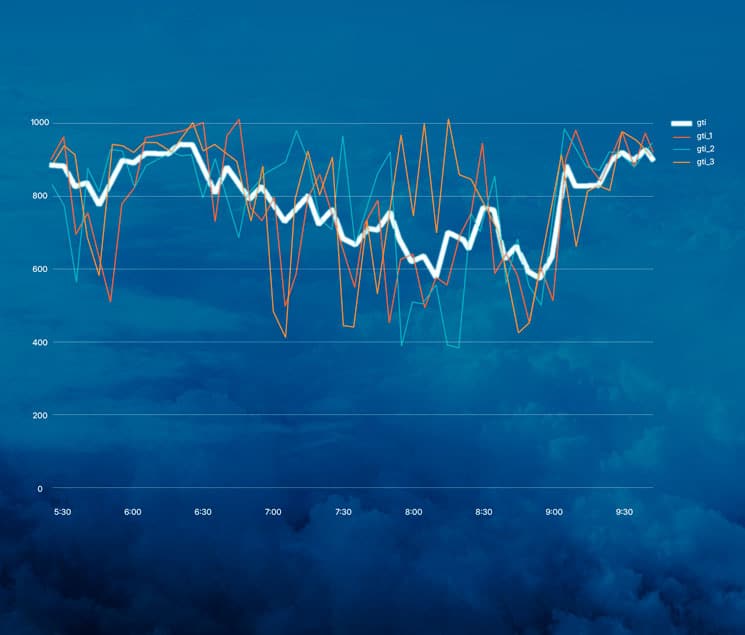
Calibsun integrates on-site solar data collected directly at a photovoltaic power plant to monitor real weather conditions in real-time. For solar power forecasting, these on-site measurements are the primary source of truth that satellite imagery and numerical weather prediction (NWP) models cannot replace at short forecast horizons.

Weather data

Weather data for solar forecasting combines 3 families: NWP, satellite imagery, ground observations. CalibSun’s meteorology team integrates the full set of meteorological variables used to estimate solar irradiance and anticipate PV production.

Solar science: Three layers, one forecast

On-site data

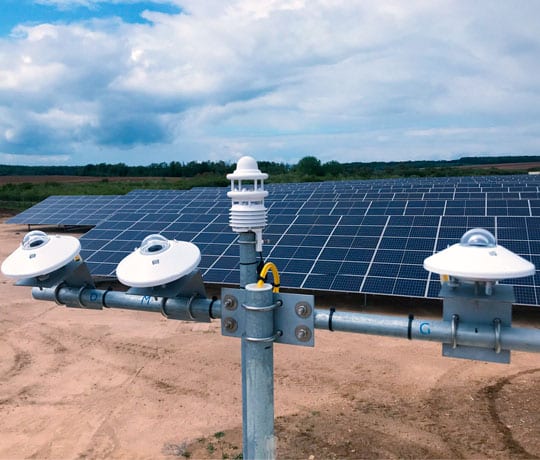
Pyranometers measuring GHI, GTI and meteorological sensors, and SCADA telemetry capturing power output.

Satellite images

Spatial coverage at regional or continental scale from geostationary satellites at high temporal frequency

Weather models (NWP)

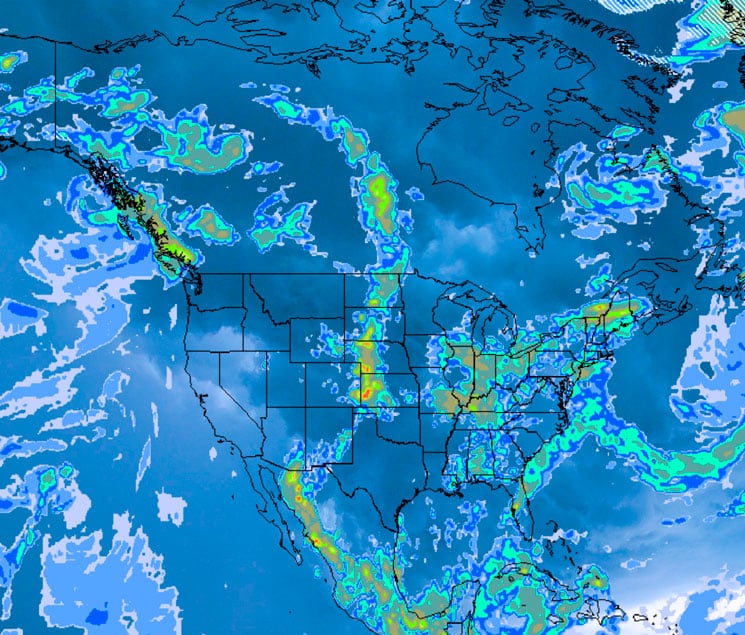
Solar irradiance as a by-product of full atmospheric state prediction at horizons from a few hours to several days ahead. 

Our resources

Customized for you

Lorem ipsum dolor sit amet, consectetur adipiscing elit. Ut et massa mi. Aliquam in hendrerit urna. Pellentesque sit amet sapien fringilla, mattis ligula consectetur, ultrices mauris. Maecenas vitae mattis tellus. Nullam quis imperdiet augue.

Scientific publications
Lorem ipsum dolor sit amet, consectetur adipiscing elit. Ut et massa mi. Aliquam in hendrerit urna.

Discover more
Solar Data
Pyranometers audit & Calibration
Use the power of on-site measurements to get a robust business model and improve the profitability of your PV projects

Discover more
Solar Science
Pyranometers audit & Calibration
Use the power of on-site measurements to get a robust business model and improve the profitability of your PV projects
Discover more
Scientific publications
Lorem ipsum dolor sit amet, consectetur adipiscing elit. Ut et massa mi. Aliquam in hendrerit urna.
Discover more
Solar Data
Pyranometers audit & Calibration
Use the power of on-site measurements to get a robust business model and improve the profitability of your PV projects

Discover more
Solar Science
Pyranometers audit & Calibration
Use the power of on-site measurements to get a robust business model and improve the profitability of your PV projects
Discover more

Solar expertise : your questions answered

  • Weather data encompasses the full atmospheric state – wind speed, precipitation, temperature, pressure, humidity, storm patterns, cloud cover – as monitored by networks of ground stations and reported by government agencies including NOAA and national meteorological services worldwide.
  • Solar data is a focused subset, centred on radiation variables: GHI, DNI, DHI, and their derived quantities. In practice, solar forecasting pipelines combine both: weather data provides the atmospheric context, while variables including solar radiation at the surface are the direct inputs to energy yield models.

Yes – satellite-derived products and NWP outputs allow solar resource estimation at any location on Earth without a single ground sensor. Public databases give access to solar data across virtually every region and country, and are widely used at the early stages of a solar project for resource screening and installed capacity estimation. However, the absence of on-site data carries a precision cost: integration of real-time irradiance and on-site power production data enables forecasts to be refined, improving the accuracy of CalibSun’s NEXT by up to +50% at 5-mins and +35% at 15-mins compared to the use of satellite post-processed images alone. On-site data is not mandatory; it is a performance multiplier.

Standard NWP-based term forecasts degrade significantly in tropical, island, high-altitude, or monsoon-affected climates, where cloud dynamics are localised and highly variable – and where installed solar capacity is growing fastest. Conventional models are not sufficient in these contexts: weather conditions are too localised and changeable, and real-time sky monitoring becomes essential. 

CalibSun’s INSTANT solution anticipates variations in photovoltaic production by detecting clouds up to 50 km away using a network of fisheye cameras, enabling utility operators and power plant managers to adjust thermal generation up to 15 minutes before solar output falls.

Markets